Thursday, 11 October 2018


STOCKPORT: bricolage town


MA Thesis (extract) Architecture and Urbanism. Manchester School of Architecture

David Chandler 2015
Royal Oak Yard


In the decade before the 19th century the cliffs were physically cut back to form a vertical face to create space for workshops and a silk mill. The Yard takes its name from the Royal Oak public house that was situated opposite the entrance to Little Underbank. In terms of land use the yard was tied for two centuries to the fortunes Adlington Square. The enclosure of the yard has visibly truncated a route that would have logically joined Great Underbank.

The need to restore this inarticulate space could probably be one of the most important and understated urbanist interventions inside the heritage/listed town. The Yard is does not immediately sit on one of the so called "fault lines" between the modernist masterplan of the 1960s and pre-war Stockport but a closer consideration reveals the rebuilt "insula" of the red brick buildings that fit between Pickford’s brow and Great Underbank are part of a late 20th century consolidation of the plan of the boundary of the yard.


The red sandstone cliffs have been progressively cut back to create a proto-street that was not naturally formed in the space. The demolished Astoria Cinema was a major landmark that put this Yard into shadow and kept its identity as an unsavoury urban gully. The demolition of the cinema opened the possibility of an urban steps link from this deep section of Stockport to the summit of Pickford’s Brow. Contract car parking terraces also reveal an attempt to organise the High Bankside brow from 1968 and these simple bricoleur structures built from breeze blocks and cement pads settled the high gradient side of the yard with a sense of 20th century motor town purpose; highway, car parks, roadside splay and fences. Even part of the primitive cobbled road of the original Victorian High bankside was sealed into a walled precinct in sight of the yard and is documented in the site reports of 1968. The only factor that prevented the yard becoming a road was that it was locked in by landlords and listed properties. So it too became a default car park, without any sense of the devalued potential of such an identity. The mid-20th century industrial archaeological fragments of factory spaces also condition the shape of the yard. 


Royal Oak Yard; urban walk
Royal Oak Yard introduces itself as a gap in the south side of Little Underbank with minimal sense of its importance. In the afternoon a shaft of sunlight breaks the line of the medieval main road once a main route into Manchester. A shop on the corner as we enter is vacant and the old iron place name sits above its hoarding.
There are three routes offered to the traveller as we enter the yard. To the left a promising little cobbled piazza with a raw sandstone cliff at its far end. There are some padlocked exits into Grosvenor House facing south on the High Street above. This space has been overlooked as a pocket of real heritage potential. To the right an independent stair (Wellington Steps) descends at an angle that is not a conventional doorstep, rather this flight rises all the way up the concealed red sandstone cliff to the High Street through a very well-trimmed plain brick arch, clearly marked on a plan of 1851.


This tall arch forms a typology repeated elsewhere in Little Underbank and should be seen as a remnant of the distinctive, even idiosyncratic spaces that are found in the many drawings of steps by L.S. Lowry. The route is gated and boarded off from public access. It sends a message that will be consistent for the full extent of this Victorian yard; a form of urban despair permeates all sections of the place. It assumes a defensive attitude to such town centre spaces. There is a culture of consensus amongst all the landlords in this yard that seems to assume widespread public criminal activity. This is the public façade of Royal Oak Yard; surveillance, DIY railings, gates and razor wire. The third route is that of the yard itself threading beneath the superb 1868 brick barrel vault of St Petersgate Bridge above. The six stories of Revelations House marked on 18th century maps of the area rises from a narrow granite cobbled passageway like a Victorian skyscraper, supported by its sandstone cliff. The buildings rise in area that denotes density and is the original eighteenth century business district of central Stockport. A precarious fabric that has seen some sympathetic restoration. The St. Petersgate Bridge parapet rises some 14 metres to the upper street. To the right a series of walls block a narrow access route from Little Underbank running parallel to the right of us.

Under the brick barrel vault the sides of the passage work hard as warehouse and storage. This is still a commercially functioning mews. Nevertheless the cobbled road is just over 2 metres wide and continues to welcome private car traffic as we are about to experience.


The Yard to the West of St Petersgate Bridge
Once through the arch there is an area of distinct dilapidation and neglect that promises lack of safety and unhappiness to the visitor. The beautiful sandstone cliff face is a public refuse dump with large household items sitting among refuse attracting vermin. The upper part of the cliff has
been protected by temporary canopies that protect the parked cars from falling debris and litter thrown from the street above. The steep bank side gradient is wrapped in a blue webbing fabric intended to impede vegetation, which it does not do very well. The space is further defaced by car parking structures that seem to suggest that the area has been subjected to competing land grabs.
The space seems to have become private property, covered in asphalt and sliced into parking spaces being situated only 30 metres distance from an 880 space public car park at Merseyway. The key to this area is to understand private land sales and is central to the current morphology of the yard. It is emphatically locked in as a cul de sac but has the seductive scale of a Venetian campiello, but struggles to celebrate any visitor interest in its legacy of changing use. The space represents an extensive document of urban historical archaeology. It is a Stockport narrative considerably at risk in its current condition. As we get accustomed to the space, evidence of former industrial use becomes occasionally coherent and readable as its cobbled road comes to an abrupt end. This lost piazza, whatever the future offers, is a genuine urban collage, restored, patched and piecemeal rebuilt as only bricolage can achieve over time.

The space is unseen by the public and conceals complex small scale fire escapes, air conditioning, pipe work and secured gates. Ironically the attentions of the contract car park landlords prevent the area from suffering greater destruction as CCTV is installed to watch the parked cars. We leave the



Saturday, 27 May 2017

‘The most exciting food I’ve eaten in years’

Rostron Brow leads down to Little Underbank. A great restaurant

Restaurants

Where The Light Gets In, Stockport: ‘The most exciting food I’ve eaten in years’

 
Where The Light Gets In: ‘I’d cross continents for this.’
Where The Light Gets In: ‘I’d cross continents for this.’ Photograph: Rebecca Lupton for the Guardian

Where The Light Gets In, Stockport: ‘The most exciting food I’ve eaten in years’

Not so much new Nordic as new northern, this is a procession of brilliance
Let’s get it out of the way from the get-go: Where The Light Gets In serves the most exciting food I’ve had in years. And it’s not in London, Copenhagen or Portland, Oregon; it’s in Stockport. Never have I trudged so dutifully to a destination only to exit at the other end quite so starey-eyed and evangelical.
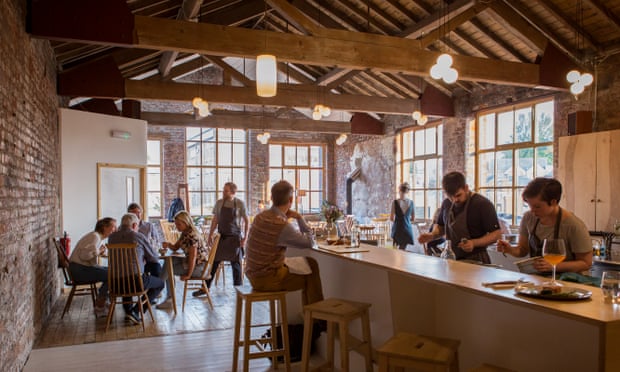
Stockport: seriously? Before high horses are clambered upon, chef/owner Sam Buckley is equally wry about the location. It is, simply, not where you’d expect this kind of firecracker creativity in £65-a-head, tasting-menu-only format. Stockport boasts restaurants called Elvis’ Kitchen (“three-course luxury meal cooked by the ELVIS chef”, which, if I’m honest, appeals hugely). And the town centre is not, well, edifying. But here, around the old market building, there’s a pleasing, brick-lined moodiness, the air scented with malt from the Robinsons brewery. Finding this former coffee warehouse proves tricky: we teeter down vertiginous Rostron Brow (“famous for its 19th-century alehouses of ill repute”) more than once before we find the entrance. So far, so Lowry. Inside, it’s a different matter, not so much open kitchen as a vast, lustworthy actual kitchen with Ercol tables dotted around. It’s the ultimate, wood-burning-stove-heated loft pad with rooftop views.
There’s no menu.
Pinterest
Tartare of Macclesfield trout. Photograph: Rebecca Lupton for the Guardian
Salt-baked beets, toasted hazelnuts, jaggy little jack-by-the-hedge leaves – aka garlic mustard plant, with all the pungency that conveys – a swirl of jammy beetroot puree and a smooth blurt of airy hazelnut almost-butter. Vegetarian wizardry, this swayed even the table’s beetroot-loathers.

Advertisement
A meaty broth, as limpid as tea, with a powder puff of wild garlic blossom to dunk in it like a teabag. It scents the broth, the broth “cooks” the blossom: brilliant in its simplicity and insanely delicious.
A cube of pink middlewhite pork, aged for five weeks in caramelised cultured butter, its fat crisped in a pan (which is where the building’s lack of extraction becomes painfully evident). Nothing else on the plate bar a few fried, fragrant leaves, herbs and flowers (they say ramsons this time, possibly sleight of hand to deflect us from other wild garlic appearances). “This,” says charming GM Emma, “is the dish that made me hand in my CV.” I’m tempted to follow suit.
I haven’t room to wax lyrical about the wine flights, notable for the consistent delivery of pure pleasure (not a given with natural and biodynamic). There’s nothing that doesn’t dazzle, from the cocktail that comes with candy-striped bags of crisps and tins of create-your-own-flavour powder made from produce that would otherwise be wasted (dried scallop plus kombu: blimey), to the tiny pastilles with the coffee that flood the mouth with sweet, boozy Buckfast, that “tonic wine” beloved of the Glaswegian jakey. Oh, OK, there is one fish dish I don’t love, woolly and underseasoned, but otherwise this is a procession of brilliance.
 

Wednesday, 26 April 2017

Little Underbank to be improved. A message from Stockprt MBC (via Twitter)

Stockport Council

         
The Council are aware of the problems with unauthorised vehicles using Lower Hillgate and Little Underbank and will shortly be installing new rising bollards to control traffic flow. There will follow a programme of repairs to the paving and stone setts. This work is being funded from the Town Centre Access Plan, more details of this can be found at


The proposed area for demolition eclipses a beautiful view of the 19th century Bank Building above it. I refer to this as one of the acropolis brows of the Underbanks. A "temple" on a hill. The proposed building will mostly screen off the promise of this part of the upper town.


HERITAGE MAGAZINE Vol. 8 No 12 Spring 2017 has new essay articles on Little Underbank

The arch opposite the steps to St Petersgate on the Heritage Magazine front cover


HERITAGE MAGAZINE Vol. 8 No 12 Spring 2017 An important contributor to wider community awareness of the potential of this beautiful little road. Here the photo shows the footings and sandstone quoins, corner blocks, of St Petersgate Bridge 1868. The Egerton Arms from the 17th century at the top of the steps and the Queen's Head at right.  The photo is particularly important because the place is lateral and not just a road for linear traffic.The Underbanks were Stockport's original 18th century business district serving the county merchants in Stockport Market Place. Many pubs were found here, used as temporary offices, dining and meeting spaces. The view is from the steps leading directly up to the Market Place. This has a tall two storey opening which is echoed in the beautiful arch leading into Royal Oak Yard seen below. The lintel at the lower right marks the closure of the old narrow passageway into Little Underbank. This could be reopened as it is narrow as certain Venetian "calli" or alleyways. This is the centre of Stockport but is at risk in ways that cannot be understated. Much of it is nearing an unsafe condition as water has penetrated the structures which have been left untenanted by landlords.

TOWARDS a SOCIAL SOLUTION to LITTLE UNDERBANK: a street dressing 2018


A 2018 one day street dressing public festival:
"let's paint Little Underbank better" The re-birth of a lost medieval street

The AIMS would be as follows:
1. re-assign the function of Little Underbank from failed roadway to secure child safe public pedestrian space (like the Shambles In York).
2. all the brows and Royal Oak Yard to be tied into the project to make an exciting little pedestrian labyrinth (like a little Venice).
3. to create a brand for the area that is distinct from Merseyway: the Heritage Lanes of medieval Stockport  (Underbanks Protected Conservation Area.) Or the STEPS and BROWS of the UNDERBANKS?

The MEANS would be creative community activist intervention with a website dedicated to community feedback. Every day in Little Underbank could be festive. The pavements could be permanently inlaid with designs and signs. Called a renaissance when this happens

A street festival. A one day (Sunday 10-4) community event in 2018 along the length of Little Underbank with a pedestrianised carriageway “dressing” from White Lion to the bollards below the brewery entrance. (Please see attachment renders) At least thirty 300cm x 300cm fabric panels with images sponsored by schools, local retailers, artists and sponsors. Fabric bunting above the road.

Only gov.uk commitment can make this happen. A number of agencies such as car parking owners, stakeholders, retailers and shuttle bus operators would need to give their support for the six hour event (+ preparation time)

The events will be filmed by BBC and other media platforms and published. 
Public consultation questionnaires at the time of the event may help to persuade the Stockport MBC road lobby of the economic advantage of a Shambles type urban district. The potential for this area is greater than both the Exchange and Redrocks developments at a fraction of the cost.

A partnership with local heritage representatives is essential for this first step in a Stockport revival. The sum of money voted to "improve" the area could easily miss its target unless demonstrable social interaction with the place can specify needs and suggest solutions.
A reconstruction render of Little Underbank with a painted or part floral street dressing s proposed. Work undertaken by a wide range of community partners; schools, sponsors, local artists. The design is not proposed here but comes from a popular event at Bolsena, Italy.
 
Little Underbank looking towards St Petersgate Bridge in a hypothetical render. Street dressings in a variety of media placed on temporary calico or linen supports. Bunting above celebrates the space of the curve of the road. An end wall of the shop units is here given addressing of the Stockport Coat of Arms in the yellow and blue found in the paintwork of St Petersgate Bridge. Note how Mealhouse Brow can be used as part of this event. The success of Little Underbanks has a great impact on Market Hall prosperity. There is already a fine piazza at this junction but it has never been put to use because it is still a hazardous motor carriageway.

The 300 metroshuttle bus


CARILLION noticed in June 2015.........

Recent heritage cobble surface at Little Underbank. If the road is pedestrianised then there are no double yellow lines so FLY PARKING is seen as a risk worth taking. Wardens report that parking tickets issued are challenged as "entrapment"

The 300 Metroshuttle bus is part of the problem in Little Underbank:
"The bus dominates the narrow medieval street - it is intimidating for people walking in the street and also limits possibilities for shops and cafes to spill out into the street. • The buses damage the cobbled surfacing with the heavy wear.  • The speed of the buses, the noise from the rumbling on the cobbles and the space taken up in the street all create a negative impression, particularly along Little Underbank and Lower Hillgate.   • Market Place & Underbanks has a relatively low priority in the routing of the bus; for instance if someone got on the bus at the interchange they are first taken to Merseyway,
then on to Tesco before looping back around into Churchgate and back into Underbanks. 
The presence of the bus makes the street less attractive to walk along, the spaces are less shared space and are very much weighted in favour of the movement of the bus when it is there.
Despite the presence of the bus stops, Little Underbanks suffers the highest rates of empty shop units in the area.  This is not a correlation; the bus is not causing the empty units but clearly the help that the bus provides is limited. 
Without the bus there is a thought that more space would be available to walk in, pavements could be used to spill out into.  The bus would still get people into the edges of the area but it would no longer run right through the heart".


UV006109 -L- Masterplan Report B Client: Carillion/Stockport MBC Document issued: June 2015
300 METROSHUTTLE emerges from Little Underbank and negotiates the unregulated driver chaos of CHESTERGATE. The current resurfacing work (April 2017) and repairs to RBS and White Lion seem to make the environment more challenging. Only contractor vehicle access is required in this zone.

Monday, 3 April 2017

Five lateral pedestrian access routes

Little Underbank is a designated and restricted pedestrian zone. Pause video to see the possibilities of lateral routes to generate safe public space